Fill out the below form to download this guide (PDF):
How to Protect Your Land with the Best Wild Hog Fence
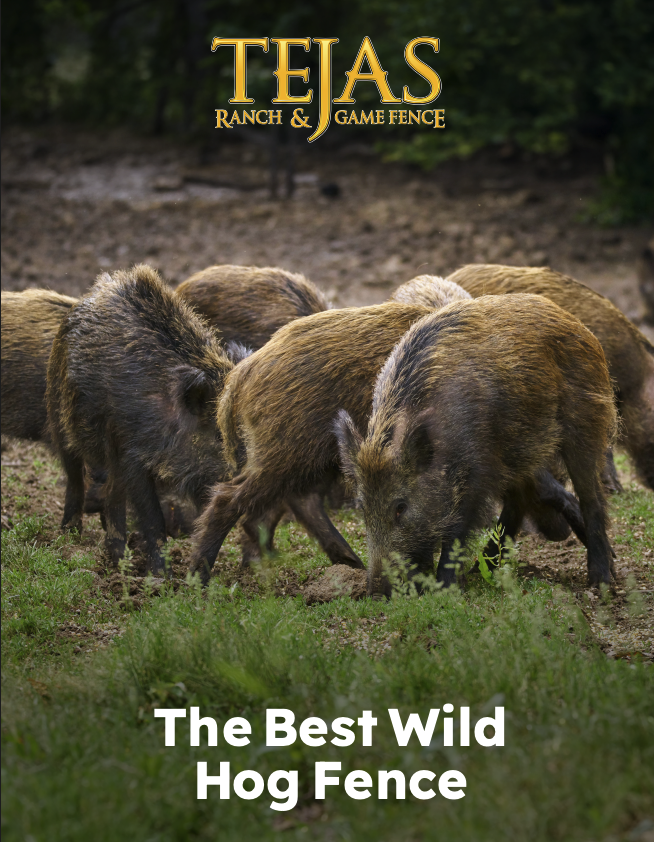
If you’re wondering how to keep wild hogs off your property, you’re not alone. It’s a question we hear almost daily. Wild hogs are not just a nuisance. They are highly intelligent, highly adaptable, and capable of catastrophic destruction. A hybrid of feral and wild swine, their impact on agriculture, land value, native ecosystems, and infrastructure grows more serious every year.
What Are These Destructive Animals?
The terms “wild” and “feral” are often used synonymously when referring to wild hogs, though they technically differ. “Feral” refers to animals that were once domesticated, while “wild” applies to animals with no domesticated lineage. These creatures are commonly called hogs, pigs, or boars, with “boar” used to describe both males and females. Their reproductive capacity is a key factor in their rapid proliferation. Sows typically begin breeding at 6 to 8 months of age, producing two litters of 4 to 8 piglets (with up to 12 piglets not being uncommon) every 12 to 15 months over a lifespan of 4 to 8 years. This prolific breeding cycle allows populations to rebound rapidly, even after significant reduction efforts. A 70% population decrease can be fully reversed within a mere two to three years.
Traditional Fences are Ineffective
Conventional fencing solutions such as barbed wire and hinge-joint mesh “field” fences have proven largely ineffective against the persistent threat of feral hogs. While multi-strand barbed wire fences may suffice for containing larger livestock, their design lacks the necessary security to deter smaller, more determined animals like wild hogs. To improve the barrier, landowners have sometimes used 6-strand fences on 6-foot T-posts. While these may provide some initial deterrence, the low-tensile wire quickly succumbs to wear and tear caused by wild hogs, deer, coyotes, and livestock, leading to breaches and eventual failure over time.